
30th November 2025 Newsletter
Hi guys. This is the eleventh newsletter from the Rejuvenation Science Institute (ICR). In these newsletters, we will tell you what we've done, since the last newsletter, to accelerate the development of rejuvenation science.
ICR signs agreement with the university Unicamp for rat rejuvenation experiment
At the end of November 2025, the Rejuvenation Science Institute (ICR) signed a research agreement with Unicamp (State University of Campinas - Brazil) to conduct the “Effectiveness test of rejuvenation in rats through the injection of extracellular particles from young pigs' plasma,” which we usually refer to as the Rat Rejuvenation Experiment with PPEPs. The rejuvenation experiment will be conducted in 2026 by the ICR in partnership with Unicamp, and the terms of this collaboration are set out in the signed agreement. On the Unicamp side, the person responsible for the research is Professor Marcelo Mori, PhD, principal researcher at the Laboratory of Aging Biology, Institute of Biology, Unicamp (Brazil).
The Rat Rejuvenation Experiment with PPEPs is an attempt by the ICR to replicate Harold Katcher's seminal experiment, in which rats were epigenetically rejuvenated by 67% — the greatest epigenetic rejuvenation ever reported in mammals. In addition to epigenetic rejuvenation, many other health parameters of the old rats returned to youthful levels. Thus, as a way to advance the science of rejuvenation, the ICR set out to verify the reproducibility of this experiment and to pursue this line of research if rejuvenation is indeed verified.
Interview with Aubrey de Grey
At the end of November 2025, ICR president Nicolás Cherñavsky interviewed the most well-known name in rejuvenation science: Aubrey de Grey. Aubrey, currently president of the Longevity Escape Velocity Foundation, told Nicolás about the longevity experiment already conducted by his foundation with mice, plans for future experiments, and his view on the ICR's work in attempting to reproduce Harold Katcher's seminal experiment. This interview is part of the ICR's efforts to disseminate scientific research in the field of rejuvenation. To watch the full interview in English, click here.
Raised funds reach 74.51% of the total
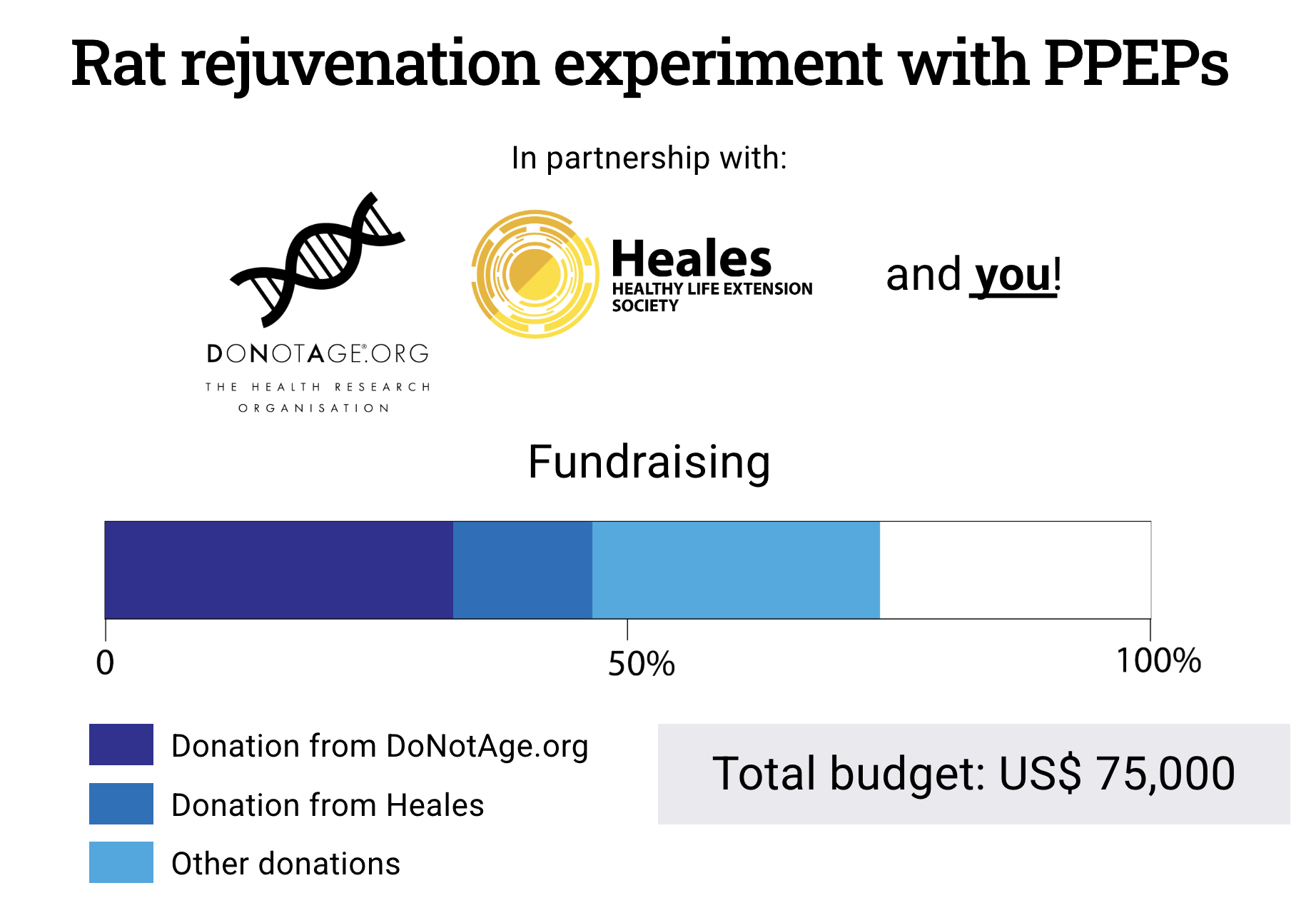
By the end of November 2025, the ICR has already raised 74.51% of the total needed to carry out the experiment to rejuvenate rats with PPEPs. This brings the total raised to US$ 55,883, with the remaining 25.49% still to be raised to reach the total of US$ 75,000. The ICR is contacting as many players in the field of rejuvenation science as possible to inform them about the experiment and the possibility of donations. In addition, we are looking for specialized media that may be interested in publicizing our initiative. So, if you know of a YouTube channel, podcast, newspaper or other media outlet that might be interested in publicizing this experiment, feel free to talk to us about it or directly to the media outlet.
Scientific dissemination article
ICR vice president Nina Torres Zanvettor had a science dissemination article published this month by Brazilian news site Sul 21. In the article, Nina explains how an AI tool applied to a clinical trial for Alzheimer's disease showed that the trial had a very positive outcome for slow progessive patients, despite the initial conclusion of negative results. This article is also part of ICR's efforts to disseminate research in the field of rejuvenation, aging, and longevity in Brazil and worldwide. To read the full article in Portuguese, click here.
This is a collective effort
This experiment is a collective effort to reproduce Harold Katcher's seminal study, in which the ICR relies on the contribution of those interested in the realization of the experiment. Thus, if you know someone who might be interested in the content of this newsletter, you can forward it to them. Also, if you are not yet a financial contributor of the ICR, we invite you to become one by clicking on this link.
So that's it. We're carrying on, and we won't rest until we've implemented rejuvenation in human beings. See you next time!