
31st December 2025 Newsletter
Hi guys. This is the twelfth newsletter from the Rejuvenation Science Institute (ICR). In these newsletters, we will tell you what we've done, since the last newsletter, to accelerate the development of rejuvenation science.
2025: rats, pigs, university, conferences, fundraising and dissemination

The year of 2025 was full of challenges for our Rejuvenation Science Institute (ICR). We started the year without having defined nor secured the rats for the rejuvenation experiment. The same applied to the collection of blood from young pigs. The procedures for the agreement with the university Unicamp (Campinas, Brazil) had not even begun. We had practically no money to fund the experiment. We had no technical staff hired to carry out the experiment. Almost no one knew that Harold Katcher's seminal experiment was going to be reproduced in a transparent manner.
Now, on the last day of 2025, all that has changed. The rats are already aging (and are now close to 25 months of age) at the university Unicamp, with which the ICR has already signed a collaboration agreement. The farm where the pigs' blood will be collected has been chosen. We have raised 75% of the total funds for the experiment. Through participation in scientific conferences, interviews, social media and personal contacts, the ICR has informed thousands of people interested in rejuvenation science about the reproduction of Harold Katcher's seminal experiment. The technical team that will carry out the experiment has also been selected and is getting ready to start.
2026: time to change the world
In early May 2026 (in just 4 months!), we will collect the blood from the pigs. We will immediately isolate the extracellular particles, and in June, we will inject the PPEPs (Pig Plasma Extracellular Particles) from young animals into rats, both to rejuvenate old rats and to keep young rats young. One month after the first injections, we should already have the first results in terms of grip strength and memory. However, regarding memory, these will only be preliminary results, as the full effect on memory can only be verified in the fifth month of the experiment, possibly in October or November 2026. The results of blood and epigenetic tests will likely be available in early 2027, but if the grip strength and memory of old rats are restored — as was seen in Katcher's original experiment — we will have a powerful indication still in 2026 that rejuvenation has occurred.
And why could this experiment change the world? Because if the rats undergo intense rejuvenation, it will prove that mammalian rejuvenation has been invented. After all, the experiment will be fully reproducible by any laboratory in the world. In addition, the rejuvenated rats will be kept alive for as long as possible at one of the most important universities in Latin America, supervised by a world-class researcher in the science of aging, Dr. Marcelo Mori. We hope that the proof that mammalian rejuvenation has come to this world will lead to a cascade of scientific, cultural, social, political and economic consequences that will take humanity to a new level in its fight for life.
Furthermore, there will be another consequence if the rats rejuvenate. This concerns our lives (Nicolás and Nina's), the lives of the readers of this newsletter, and the lives of everyone who learns about the results of the experiment. The awareness that rejuvenation in mammals is not only possible but has been achieved will change every plan we make for the future, every health-related decision we make, and every initiative we implement with long-term consequences. It will change the way we see our fathers, mothers, brothers, and sisters. It will change the way we see our friends, our countries and our favorite activities. If you want to change your life (for the better), you will certainly have your work cut out for you when you learn that it will be possible not to die if you don't want to. That is changing the world.
Before we say goodbye to 2025, we want to remind you that we still need to raise 25% of the funds for the experiment. That means we still need to raise about $18,500. With the amount raised so far, we will be able to carry out most of the experiment, but we would have to store blood samples to perform blood and epigenetic age tests only when the entire budget is complete. In other words, we have enough to carry out the experiment, but not enough to perform all the tests we want. This means that the experiment will take place anyway, but only grip strength and memory can be tested without completing the budget.
In this final stretch before the experiment begins, the ICR team will have to focus on conducting the experiment itself, and we may not have much time to talk to people asking for donations. So, we ask you to talk to anyone you can about this. The results of the experiment will belong to everyone, which is why we need your help. As we always say, this is a collective initiative, from the start to the end.
We hope that in a year's time, we will be able to send you a newsletter telling you that the old rats' memory has returned to youthful levels, as has their grip strength, and that we are waiting for the results of blood and epigenetic tests to confirm that rejuvenation has arrived in this world. Until then, we still have a great adventure ahead of us. Best wishes and happy 2026!
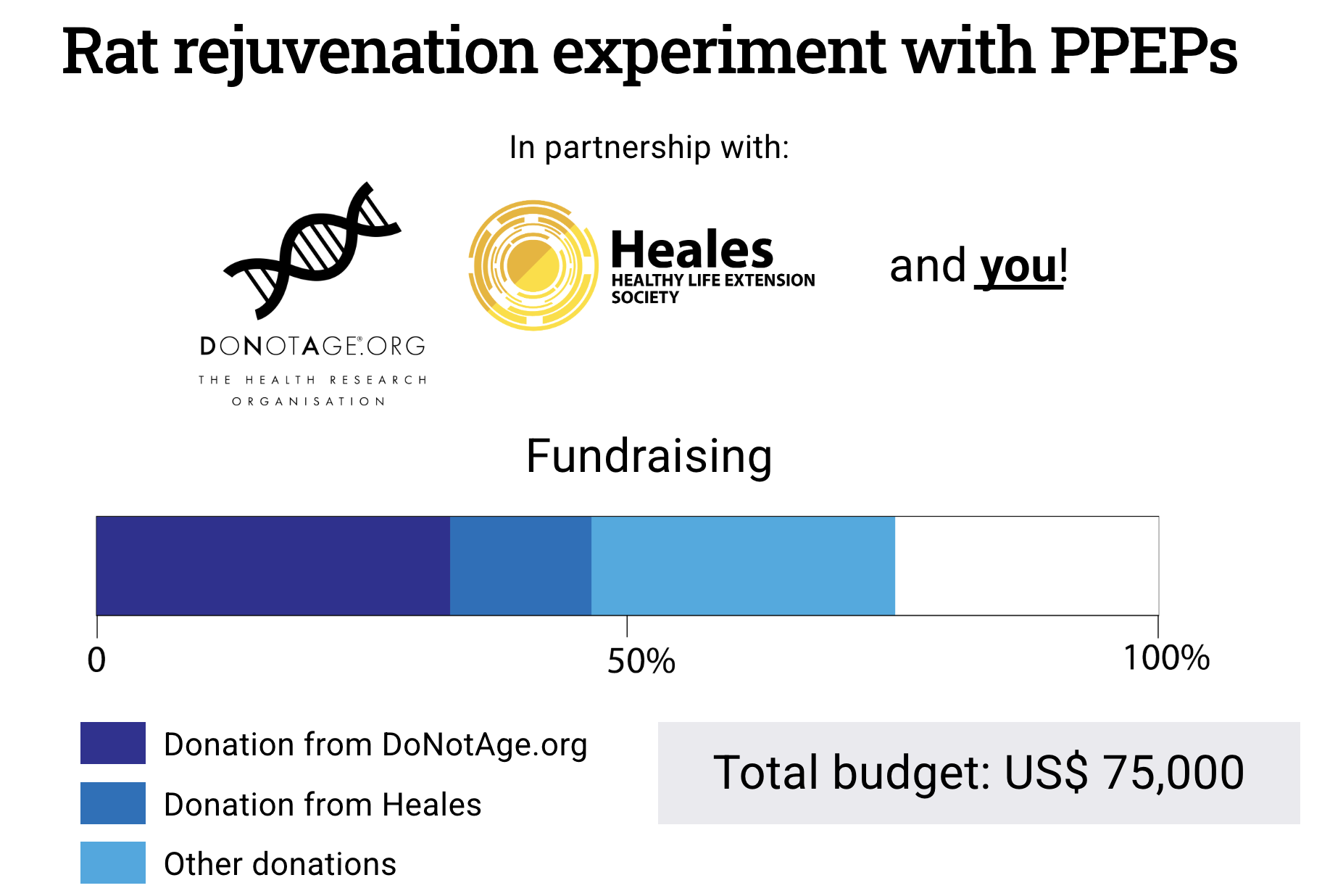
Raised funds reach 75.27% of the total
By the end of December 2025, the ICR has already raised 75.27% of the total needed to carry out the experiment to rejuvenate rats with PPEPs. This brings the total raised to US$ 56,449,48, with the remaining 24.73% still to be raised to reach the total of US$ 75,000. The ICR is contacting as many players in the field of rejuvenation science as possible to inform them about the experiment and the possibility of donations. In addition, we are looking for specialized media that may be interested in publicizing our initiative. So, if you know of a YouTube channel, podcast, newspaper or other media outlet that might be interested in publicizing this experiment, feel free to talk to us about it or directly to the media outlet.
This is a collective effort
This experiment is a collective effort to reproduce Harold Katcher's seminal study, in which the ICR relies on the contribution of those interested in the realization of the experiment. Thus, if you know someone who might be interested in the content of this newsletter, you can forward it to them. Also, if you are not yet a financial contributor of the ICR, we invite you to become one by clicking on this link.
So that's it. We're carrying on, and we won't rest until we've implemented rejuvenation in human beings. See you next time!