
31st August 2026 Newsletter
Hi guys. This is the twentieth newsletter from the Rejuvenation Science Institute (ICR). In these newsletters, we will tell you what we've done, since the last newsletter, to accelerate the development of rejuvenation science.
Harold Katcher is clarifying our doubts about his scientific articles
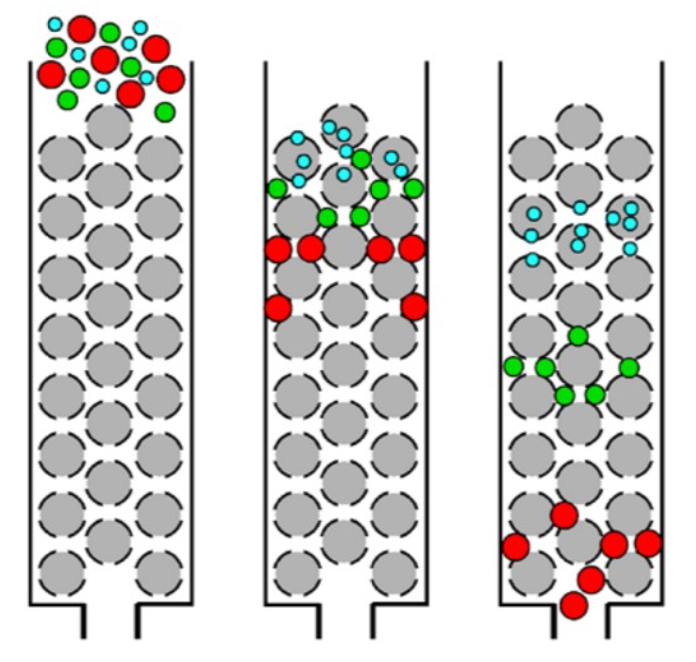
What happens inside a chromatographic column
In the last few weeks, Harold Katcher, the creator of the rejuvenation therapy that our institute is attempting to replicate, has begun to clarify the doubts we had regarding his scientific articles — both the 2023 article, published in the journal Geroscience, and the 2024 article, published in the journal Aging Cell. Both articles contain ambiguous passages, which caused a lot of difficulties during our first attempt at replication, conducted in March of this year. Without these clarifications, we do not see how the March experiment could have replicated the results of Katcher’s seminal experiment.
For example, in the 2023 article, the dose was established based on the weight of the “precipitate”; however, it was not clear in the article whether this “precipitate” referred to the intermediate precipitate, which forms after the addition of PEG, or to the final precipitate, which forms after the use of the dialysis membrane. Since this was unclear, we had to use other criteria to determine the dose, which may have resulted in a dose that was very different from the one Katcher used in his experiment.
Another example is the way the chromatographic column was used. In Katcher’s articles, it is merely stated that a Sephadex column was used, but there is no mention of how — which fractions were collected, for example. Therefore, in March we decided to replace it with an Izon column, which comes standardized from the factory. However, the fractions collected in March were not necessarily the same as those collected by Katcher using the Sephadex column.
And there are many more differences between what we did in March and what we’ll be doing now, both in the rat experiment (which will resume in November of this year) and in the mouse experiment. By the way, how is the Mouse Rejuvenation Experiment coming along?
Why did the start of the Mouse Rejuvenation Experiment had to be postponed from July to September/October 2026?
The start of the experiment in July of this year was set when our institute had an agreement with Dr. Marcelo Mori from the university Unicamp that the Mouse Rejuvenation Experiment would be conducted jointly by our institute and his laboratory. In fact, the Rat Rejuvenation Experiment is being conducted (and this has not changed) in collaboration with Dr. Mori’s laboratory. However, a few weeks ago, Dr. Mori told us that his laboratory would find it difficult to conduct two experiments with high expectations — the Rat Rejuvenation Experiment and the Mouse Rejuvenation Experiment — simultaneously. Thus, our institute decided to move forward with the Mouse Rejuvenation Experiment without the collaboration with Unicamp. However, in this case, the technical difficulties could be very significant unless…Harold Katcher stepped in. Consequently, Unicamp’s withdrawal from this experiment and its subsequent postponement allowed us to avoid starting it without Katcher’s clarifications, which exponentially increased our chances of successfully replicating his seminal results in the Rat and Mouse Rejuvenation Experiments.
Another consequence of Katcher’s clarifications is that we now realize that the fact that we were unable to replicate his results on grip strength in March does not mean that his method does not work, given the many differences between the actual method and what we had interpreted from the articles in March. This brings us great relief and fills us with hope as we focus on this year’s experiments with rats and mice. And what’s the status of the Mouse Rejuvenation Experiment?
What is the current status of the Mouse Rejuvenation Experiment?
To explain the current status of this experiment, there’s nothing better than describing our day today. We spent the day purchasing the materials and reagents we’ll use in the experiment. We spoke with three suppliers, clarifying all the specifications and calculating how many days it will take for each item to arrive. In addition, we’re looking forward to tomorrow’s meeting on the ethical use of animals, which refers to our experiment. As for the aged mice, we had to take care of the details involved in transferring the animals to the animal facility where the therapy will be administered. Not to mention that today we were expecting a response regarding the availability of a mouse strength-testing machine, which may arrive tomorrow. It’s a frenetic pace, but it’s worth it, and it’s going to work out — we don’t know if we’ll be able to replicate Katcher’s results, but we’re going to conduct the experiment, and quickly. We expect to collect blood from the pig sometime in September, or perhaps in early October, and begin the injections in the mice around mid-October.
This is a collective effort
This experiment is a collective effort to reproduce Harold Katcher's seminal study, in which the ICR relies on the contribution of those interested in the realization of the experiment. Thus, if you know someone who might be interested in the content of this newsletter, you can forward it to them. Also, if you are not yet a financial contributor of the ICR, we invite you to become one by clicking on this link.
So that's it. We're carrying on, and we won't rest until we've implemented rejuvenation in human beings. See you next time!