
Hi guys. This is the twenty-second newsletter from the Rejuvenation Science Institute (ICR). In these newsletters, we will tell you what we've done, since the last newsletter, to accelerate the development of rejuvenation science.
We only achieved a 4% increase in the mice's grip strength; after talking with Katcher, we understood why
Last Friday, October 30, we conducted the first grip strength test following the first dose of the Mouse Rejuvenation Experiment, a replication of Harold Katcher’s seminal rejuvenation experiment. We observed only a 4% increase in grip strength in the treated mice compared to the control animals, so we spoke with Harold Katcher today to understand why. What happened was that, while working in the lab to prepare the dose, some questions arose, and we were unable to speak with Katcher at that time. As a result, we ended up producing a dose that was about 27% as potent as it should have been.
Katcher had told us that we should collect the opalescent (milky-looking) fraction of the solution eluting from the chromatographic column. However, there was a gradient of opalescence, starting with a clearly opalescent portion and gradually becoming less opalescent, and we didn’t know how much of this increasingly less opalescent fraction we should collect. In our conversation with Katcher today, it became clear that we should have collected slightly less than half of what we actually collected. Furthermore, likely because of this, the semisolid obtained after concentration on the dialysis membrane could not be completely dissolved for the preparation of the injections, and we collected only the portion that we were able to dissolve. Finally, when administering the injections, the veterinarian did not inject a small portion of the vial’s contents to prevent air bubbles in the syringe. Taking all these losses into account, the dose we administered to the mice was, as mentioned, approximately 27% of the dose we should have given, which may explain the weak effect.
We’ll conduct another strength test on the mice on November 20, and then we’ll do another one before the second dose is administered to the mice in January 2027. With this second dose, we’ll try to correct the issues we encountered with the first dose in the mice. In fact, during today’s conversation with Katcher, we agreed that if we have any questions during the laboratory procedures that aren’t answered in his scientific articles, we can contact him immediately. In addition, in mid-November, we will restart the Rat Rejuvenation Experiment, and we will use all the experience we’ve gained so far to adjust the dose so that we can finally replicate the results of Katcher’s original experiment.
We’re currently packing our bags to head to Brussels to give a presentation on our replication of Katcher’s seminal experiment at the Euro-Symposium on Healthy Aging and Longevity at 9:30 a.m. on Friday, November 6 (see the event website here). If you’re able to attend, it would be a pleasure to meet you in person!
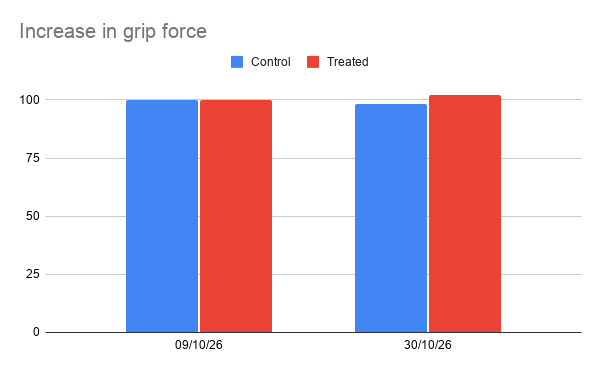
Percentage increase in grip strength. Average percentage increase for each animal. The control animals showed an average decrease of 1.96%, while the treated animals showed an average increase of 2.04%. There was no statistically significant difference between the two groups (p = 0.62).
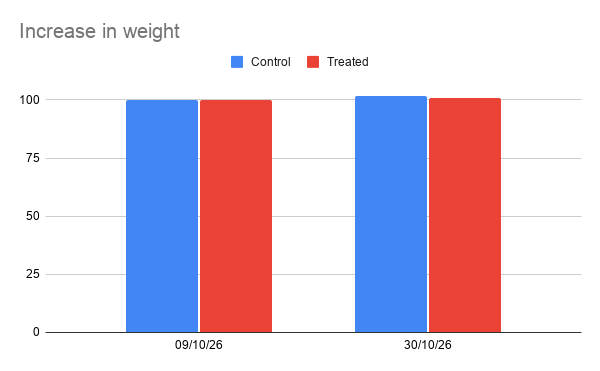
Percentage increase in weight. Average percentage increase for each animal. The control animals gained an average of 1.75%, and the treated animals gained an average of 0.76%. There was no statistically significant difference between the two groups (p = 0.58).
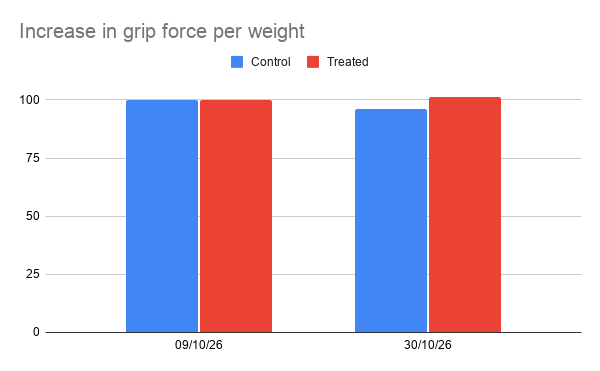
Percentage increase in strength per animal weight. Average percentage increase for each animal. The control animals decreased by an average of 4.07%, and the treated animals increased by an average of 1.24%. There was no statistically significant difference between the two groups (p = 0.44).
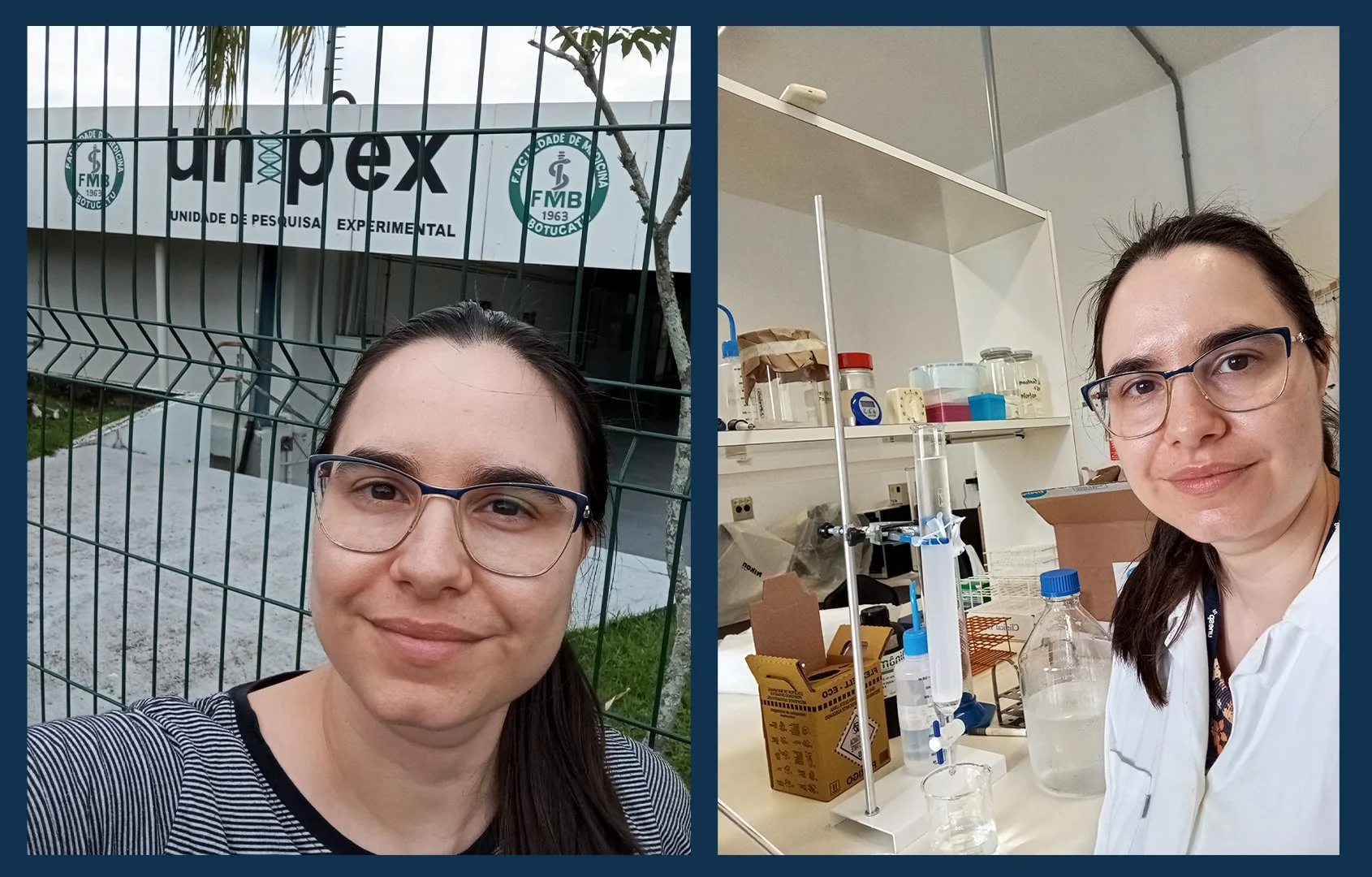
Nina in front of the Unipex building (left) and in the lab doing the experiment (right). Nicolás was present during the mice’s strength test, the blood collection, and the administration of the dose, but he forgot to take pictures.
This is a collective effort
This experiment is a collective effort to reproduce Harold Katcher's seminal study, in which the ICR relies on the contribution of those interested in the realization of the experiment. Thus, if you know someone who might be interested in the content of this newsletter, you can forward it to them. Also, if you are not yet a financial contributor of the ICR, we invite you to become one by clicking on this link.
So that's it. We're carrying on, and we won't rest until we've implemented rejuvenation in human beings. See you next time!