
30th April 2026 Newsletter
Hi guys. This is the sixteenth newsletter from the Rejuvenation Science Institute (ICR). In these newsletters, we will tell you what we've done, since the last newsletter, to accelerate the development of rejuvenation science.
A key moment in our experiment
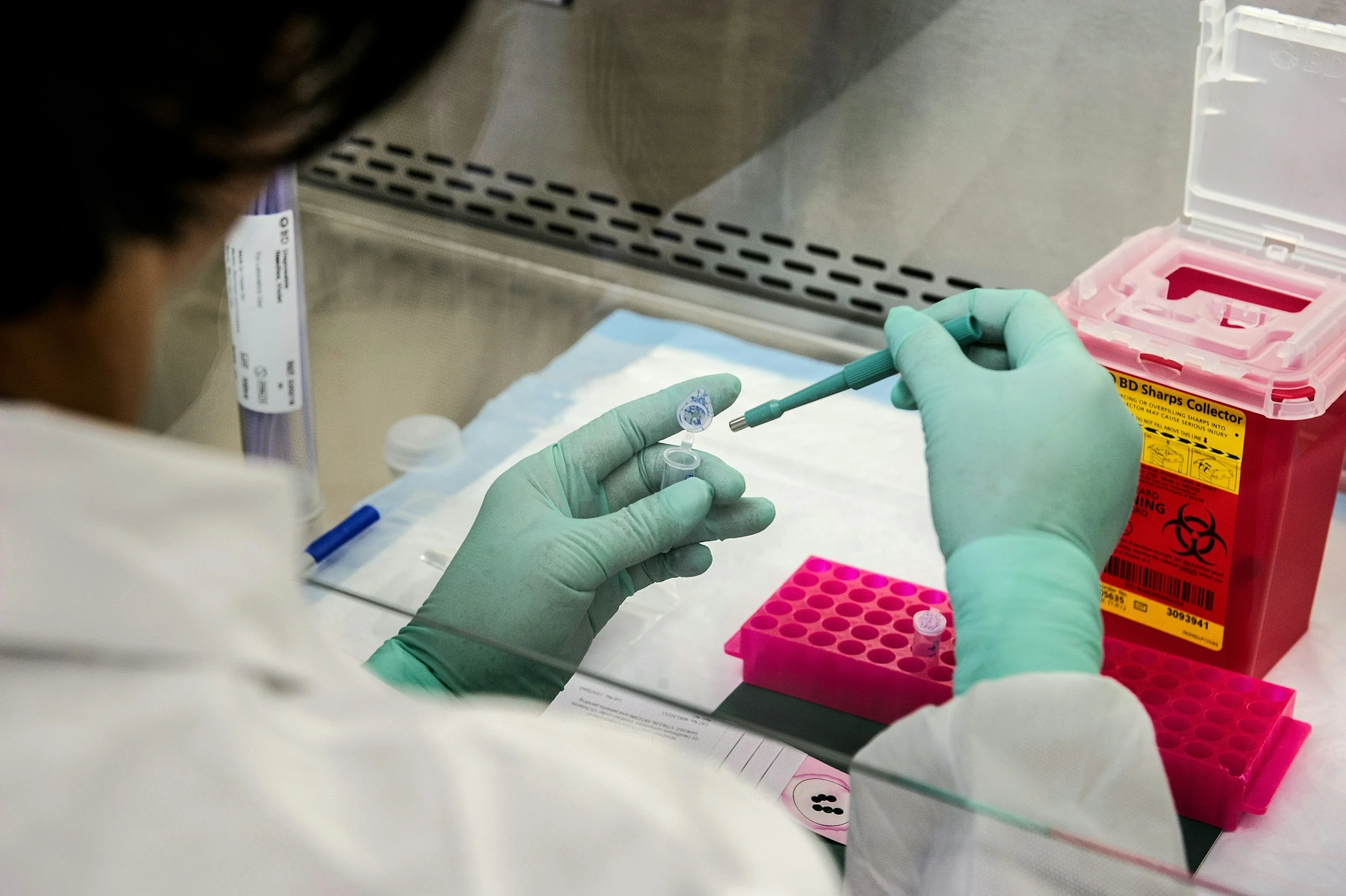
This newsletter is different from previous ones. It includes a lot of technical content to explain the results we’ve obtained so far and how the experiment will proceed. The scientific articles published by Katcher weren’t particularly clear or complete (something we only realized once we put them into practice), and so this first phase of the experiment we’ve conducted so far has helped us make the experiment much more robust.
When we began replicating Katcher’s seminal experiment based on his 2023 article published in the journal Geroscience, we realized that the article referred to the entire content of exosomes from the plasma of young pigs as the rejuvenating component, defined as extracellular vesicles ranging in size from 30 to 150 nanometers. However, upon analyzing another article by Katcher published in the journal Aging Cell in 2024, it becomes clear that the rejuvenating component is not described as the entire content of the exosomes, but as a specific and relatively small portion of that content. It is important to note that, in the composition described in the Geroscience article, Katcher also described the inclusion of extracellular vesicles larger than exosomes. Thus, there were two possible compositions to be tested. The first composition we produced was based on the first article, published in Geroscience in 2023.
The results of testing this first composition on old rats showed that it did not rejuvenate the animals. We performed a grip strength test before the injections and two grip strength tests after the injections. If rejuvenation had occurred and we had replicated Katcher’s results, grip strength would have been considerably higher 15 days after the end of the treatment injections. However, there was no significant difference at that point between the animals in the control group and the treated group. Below you can see the results of the three grip strength tests. The increase in grip strength in both the control and treated rats after treatment administration was likely due to a training effect in the animals (they were more accustomed to performing the test).
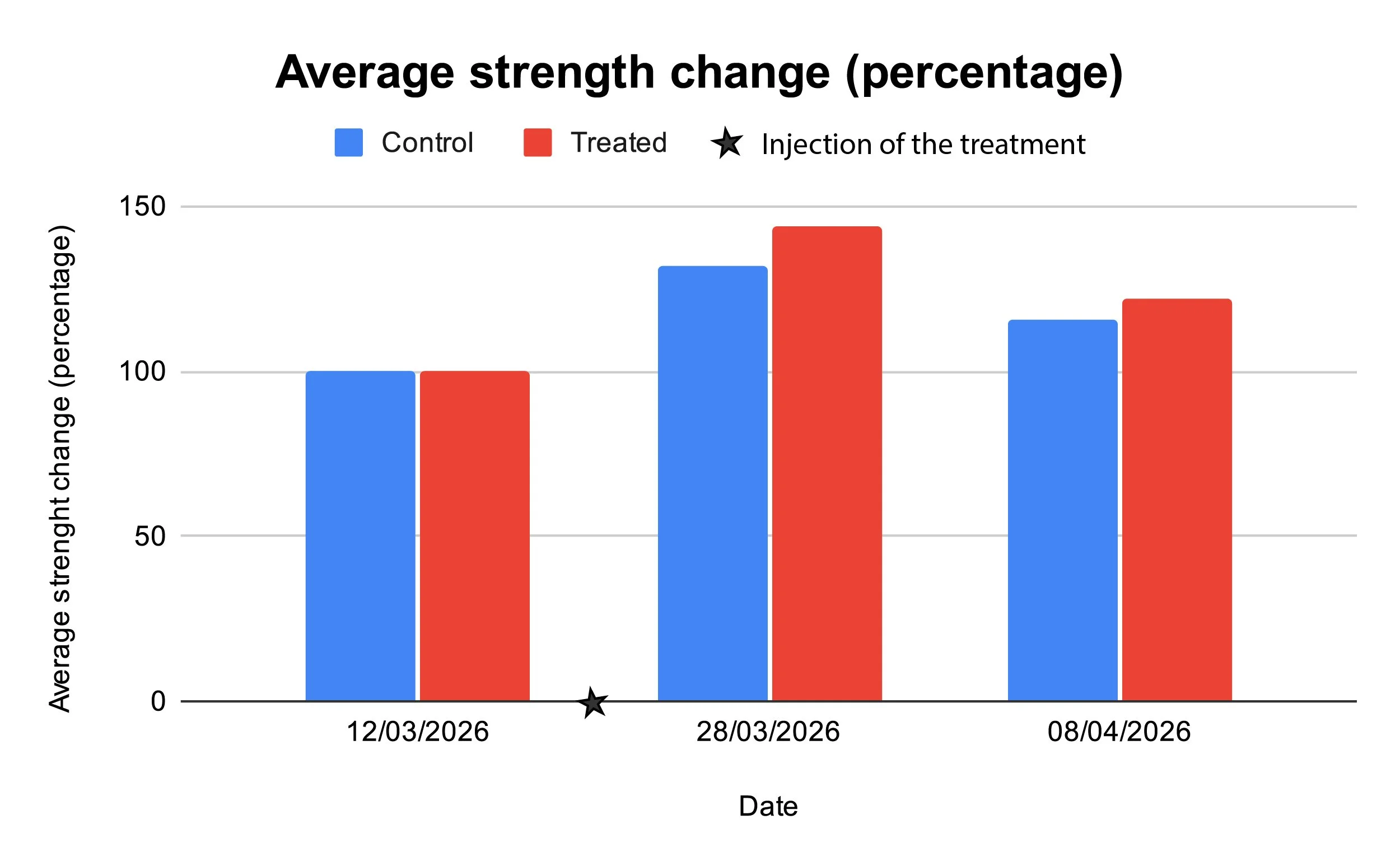
Average change in grip strength, expressed as a percentage. Control animals are shown in blue, and treated animals in red. The star indicates when the treatment was administered.
In addition, weight loss was approximately the same in the control group and the treated group, as can be seen in the graphs of the four weight measurements below.
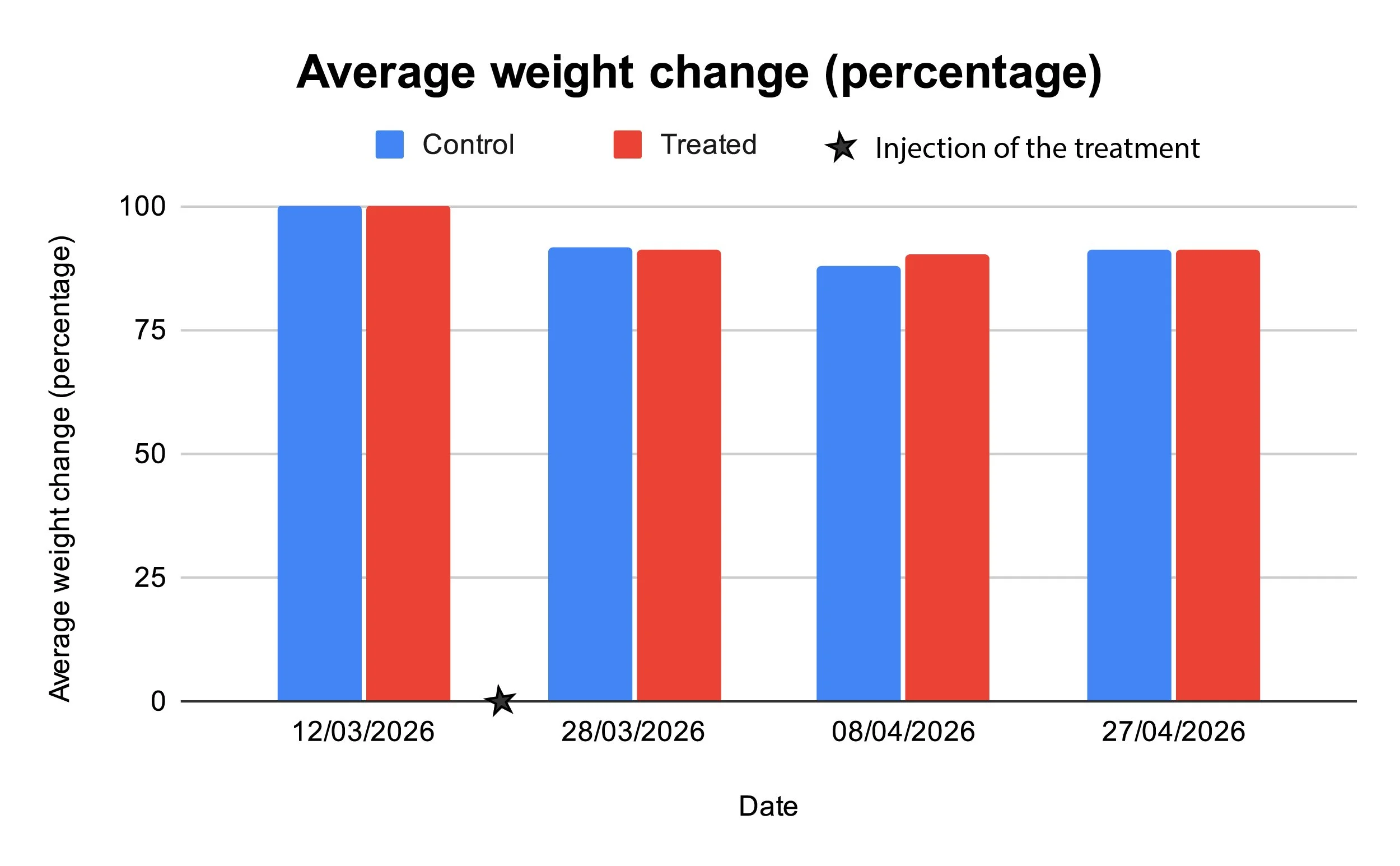
Average change in weight, expressed as a percentage. Control animals are shown in blue, and treated animals in red. The star indicates when the treatment was administered.
We also collected blood samples from the rats before and approximately one month after treatment. We will have the results of these blood tests once the entire experiment is complete. However, based on the grip strength and weight measurements, it was clear that Katcher’s results were not being replicated. Since the rats were (and are) already very old and frail, we decided not to conduct the memory test (which takes 9 consecutive days, and for which the rats need to be transferred to another facility), also because, in Katcher’s experiment, the first memory test showed a relatively small improvement, since, apparently, memory is one of the last things to improve during rejuvenation.
In conclusion, in this first part of the experiment, we were able to test a total exosome composition (based on the 2023 article in Geroscience), and the result was that it did not cause acute rejuvenation as reported in Katcher’s experiment.
Second composition will be tested in early November
We are now preparing to test the second composition (the one based on the 2024 Aging Cell article). Last week, we went to the farm to collect pig blood to begin preparing this composition. The problem is that, since this new composition uses only a small fraction of the total range of exosomes, a larger amount of pig blood is needed to produce it. In addition, the time required to collect the appropriate fractions on the chromatographic column is longer. We also cannot use the same rats to test this new composition, as they are already too frail and old. Therefore, for the new composition, we will use a new group of old rats that will only be at the right age for treatment in early November, about six months from now. In any case, we would need several months to prepare the new composition, also because, in early November, we will inject the composition not only into old rats, but also into young rats.
In the first treatment, using the first composition, we used rats with an average age of 21 months; there were 10 rats in the treated group and 10 in the control group. However, the animals began to die very early, in both the treated and control groups, and so we are certain that, after 5 months — which is the planned duration of the entire experiment — even if the treatment were successful, we would have far fewer than 10 animals in the control group, which would compromise the statistics. Therefore, for this new composition, we will use “younger” old animals, approximately 12 months old. This way, we will be able to complete the full 5 months of the experiment, including the two doses (spaced 3 months apart), and we will be relatively certain that, 5 months later, we will still have 10 rats in the control group, or close to that number.
Survival curve for rats
By the way, this was a very important finding we made while conducting this first part of the experiment: it is extremely difficult to conduct the 5-month experiment (including two doses separated by 3 months, grip strength tests, memory tests, blood markers, and epigenetic tests) if we start the experiment after the Sprague Dawley rats are already over 20 months old. In the Geroscience article, the initial age of the old rats was not described precisely, but is indicated in the text as being between 18 and 24 months and in the graphs as being around 25 months. In the Aging Cell article, the initial age of the old rats is described as being 24 months.
However, based on the survival curve we obtained from the rats we initially had (shown below), we concluded that, in order to conduct the entire 5-month experiment and complete it with 10 animals (or so) per group, we would need to start the experiment when the middle-aged/old rats are 12 months old, ending it when they are 17 months old — certainly already old. Therefore, when we inject the new composition in early November, we will begin the experiment with the old rats with the animals being 12 months old. The young animals will be about 7 months old in early November. In the graph below, which corresponds to our rat survival curve, you can see that by the age at which we injected the first composition (20 months of age for one group of rats and 22.5 months of age for the other), about 50% of the 42 rats we initially had had already died.
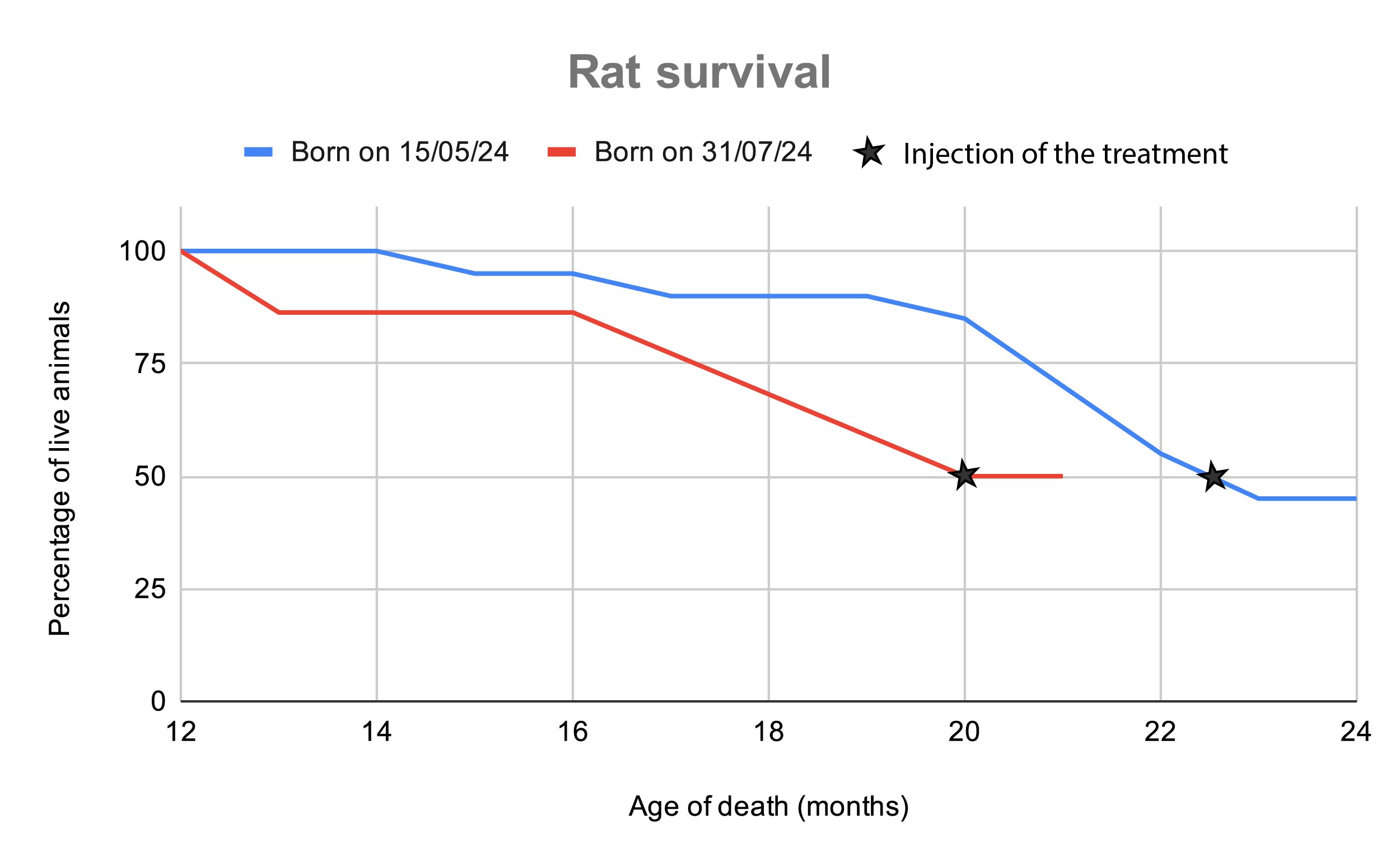
Survival curve showing the percentage of live animals versus their age in months. Animals born on May 15, 2024, are shown in blue, and those born on July 31, 2024, are shown in red. The star indicates when the treatment was administered.
In summary, in early November (six months from now), we will test a specific exosome composition (based on the 2024 paper in Aging Cell) rather than a composition containing all exosomes. The difference between the two compositions is significant, so we believe the final outcome of the experiment remains quite uncertain. Over the next six months, we will need to produce the new composition in sufficient quantities for two doses for 10 old rats and 10 young rats, which will likely be a challenge, given that the amount of pig blood required and the processing time will be greater than for the first composition. Incidentally, the discovery that the second composition takes longer to produce than the first may partly explain why Katcher so frequently mentions in his interviews the difficulty of producing the rejuvenating compound in the quantity needed to rejuvenate a human or large animals. Apparently, this small fraction of the exosome pool takes a long time to isolate, and that is what we will discover and share with you in this new phase of the experiment, at the end of which we hope to have rejuvenated rats. The fight continues!
References:
2023 article in Geroscience: Reversal of biological age in multiple rat organs by young porcine plasma fraction
2024 article in Aging Cell: E5 treatment showing improved health-span and lifespan in old Sprague Dawley rats
This is a collective effort
This experiment is a collective effort to reproduce Harold Katcher's seminal study, in which the ICR relies on the contribution of those interested in the realization of the experiment. Thus, if you know someone who might be interested in the content of this newsletter, you can forward it to them. Also, if you are not yet a financial contributor of the ICR, we invite you to become one by clicking on this link.
So that's it. We're carrying on, and we won't rest until we've implemented rejuvenation in human beings. See you next time!